
ERPC launches Shreds UDP Forwarding Premium, a low-latency Solana data stream in seven regions
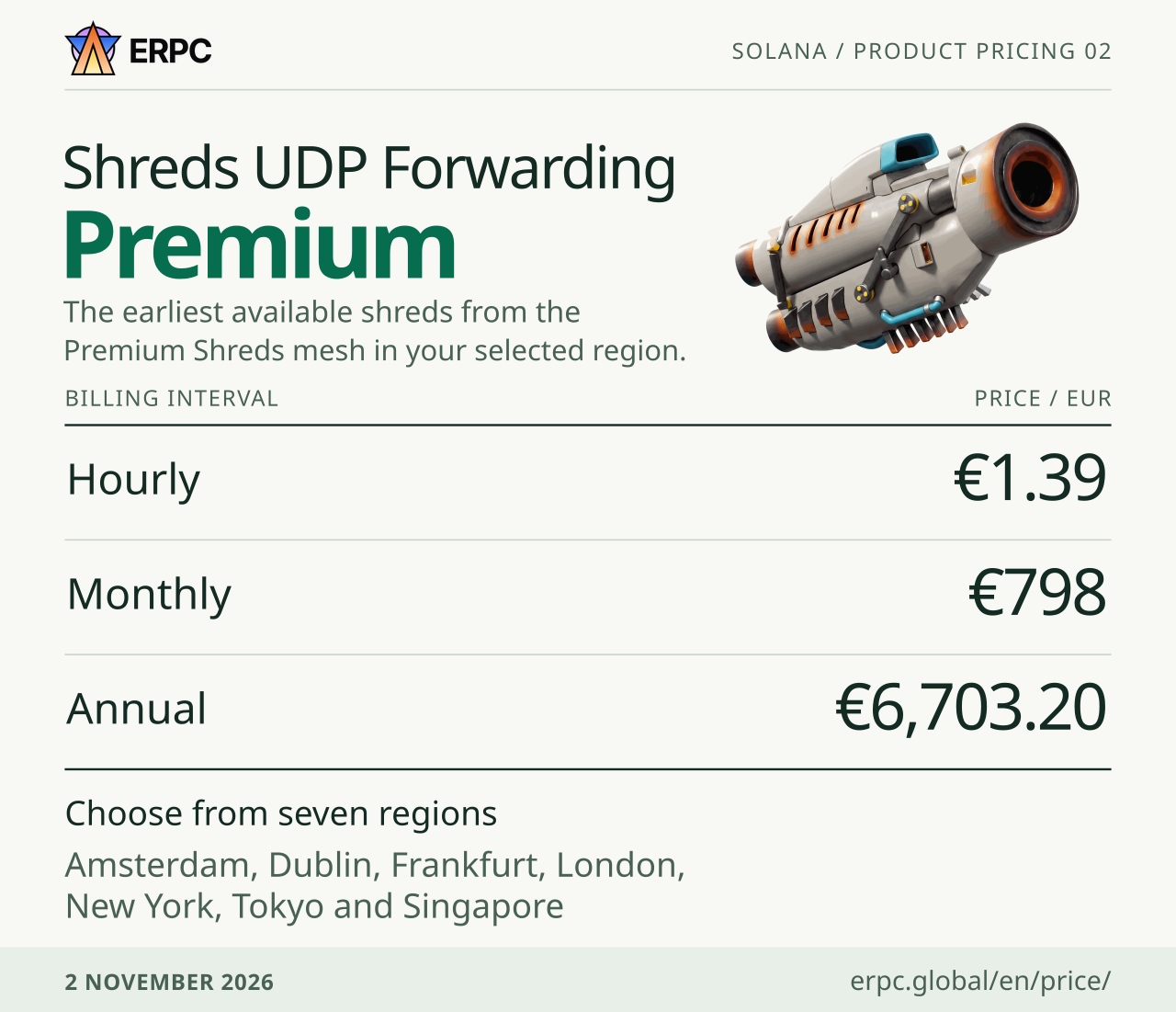
ERPC, operated by ELSOUL LABO B.V. and Validators DAO, has launched Shreds UDP Forwarding Premium in seven regions. Each region has its own Premium Shreds mesh. From the region you select, Premium delivers the earliest available raw Solana shreds over UDP to your receiver. Hourly access is €1.39.
Single-node delivery on Standard and a data mesh on Premium
Standard delivers raw Solana shreds from a single node. Premium gathers shreds from multiple nodes through a data mesh in each region and forwards the earliest copy of each shred available to that mesh to your receiver. By delivering the first arrivals across the mesh, Premium is designed to increase the share of shreds that reach you sooner than with single-node delivery.
For an application watching an on-chain market, the useful timestamp is when its own receiver has enough data to recognize an instruction. ERPC measured packet arrival in Frankfurt. With hourly access, you can also measure when your application detects the same event on the route you plan to use.
From the first packet to the instruction you care about
Consider a service watching a Solana program for instructions that initialize a new token mint. Its first job is to recognize the instruction, extract the mint address and pass that address to the next stage. A shred carries a fragment of block data. As soon as enough fragments arrive, the receiver can reconstruct the entries and inspect their transactions while the rest of the block is still arriving.
The Solana Stream SDK’s Rust receiver implements that path. It decodes UDP datagrams, assembles shreds into entries and passes matches to a configurable watcher. You can replace the example detection rule with your own program filter and send matches to your own queue. For a swap, the instruction can tell you the limit a participant specified. To find out what actually filled, use execution metadata from Geyser gRPC or RPC.
What the Frankfurt receiver measured
ERPC introduced UDP Forwarding Standard in September for developers who want to receive raw Solana shreds on their own hosts. Both plans let you select a region and register your public IPv4 address and UDP port. That common setup let us compare the two feeds on one machine. September’s Shredstream UDP Forwarding launch
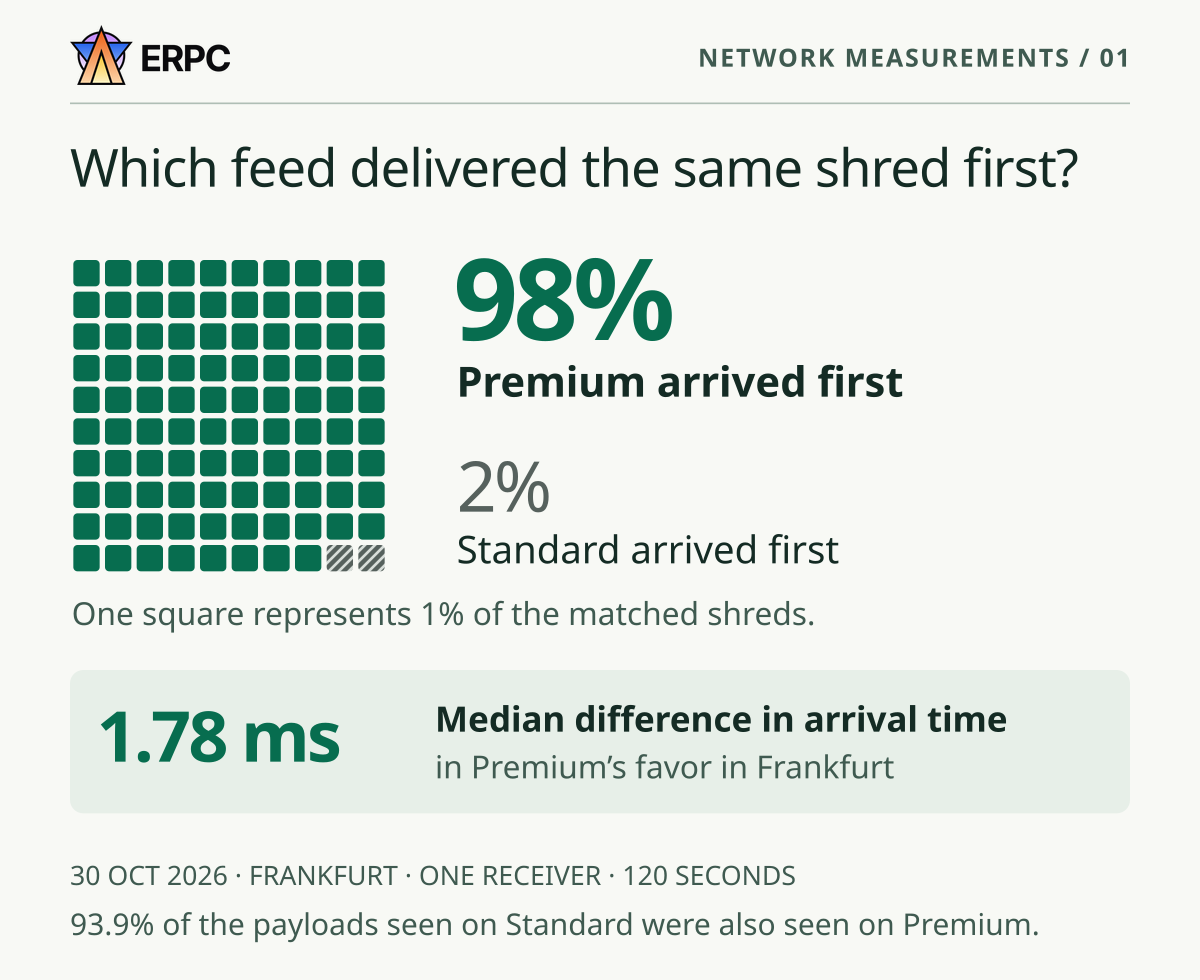
On October 30, 2026, ERPC ran the two feeds side by side for 120 seconds in Frankfurt. A single packet capture recorded both ports against the same clock. We matched identical UDP payloads and kept the first arrival on each feed. Of the payloads observed on Standard, 93.9% also appeared on Premium during the capture. Premium was first for 98% of that matched set. The median arrival difference was 1.78 ms.
| First-arrival difference on the same receiver | p10 | p50 (median) | p90 | p99 |
|---|---|---|---|---|
| Standard timestamp minus Premium timestamp | 0.94 ms | 1.78 ms | 2.68 ms | 3.89 ms |
Premium often arrived 1–3 ms earlier in this run. How much of that lead reaches your application also depends on when the remaining fragments arrive and how long your decoder and queues take.
Measure packet arrival and application detection separately
To compare the feeds on your own infrastructure, run them simultaneously into separate UDP ports on one host. Match identical payloads and compare their first arrival times. Keep the unmatched counts for each feed alongside the median, the 90th percentile and the share that arrived first. Repeat the comparison at different times on the route you plan to use.
Then timestamp when each pipeline emits a match for the same transaction signature and instruction index. The difference between those two timestamps tells you how much sooner your own service detected the event. If the packet lead narrows by the time your watcher fires, the timestamps show where to look next. Receiver configuration and packet checks
Shreds and finality under Alpenglow
Solana’s Votor voting protocol went live on mainnet on October 21. Turbine still propagates the block data as shreds. Rotor, its planned successor, is a later phase. A receiver can inspect an instruction as the data arrives, then use the appropriate consensus signal when its application needs a finalized result. The Frankfurt benchmark measured the first step. Solana Foundation’s Alpenglow guide · SIMD-0326
Regions, pricing and access
Choose Amsterdam, Dublin, Frankfurt, London, New York, Tokyo or Singapore. Each subscription forwards from one selected region to one public IPv4 address and UDP port.
| Billing interval | Premium price on November 2, 2026 |
|---|---|
| Hourly | €1.39 per hour |
| Monthly | €798 per month |
| Annual | €6,703.20 per year |
In the ERPC dashboard, open Shreds UDP Forwarding under Shreds, choose Add, then select Premium and your billing interval. Register your receiver and allow inbound UDP to its port from every source IP shown in the dashboard. Once the destination is active, confirm packet arrival before starting your benchmark.