ERPC Releases Best Practices and Code Example Documentation for Stable Operation of Solana Geyser gRPC
ERPC Releases Best Practices and Code Example Documentation for Stable Operation of Solana Geyser gRPC
ERPC, operated by ELSOUL LABO B.V. (Headquarters: Amsterdam, Netherlands; CEO: Fumitake Kawasaki) and Validators DAO, has released new documentation to improve stability and usability in real-world operation of its Solana Geyser gRPC endpoints, which continue to see performance improvements across all regions.
The newly published materials consist of two pages: a Best Practices guide for running Geyser gRPC reliably in production environments, and Code Examples centered around practical, working Rust implementations.
Practical Challenges in the Adoption of Geyser gRPC
Geyser gRPC is a powerful interface for retrieving Solana blockchain events—such as transactions, accounts, and slots—with low latency. However, in the web development ecosystem, WebSocket-based streaming has long been the dominant pattern, and experience with bidirectional gRPC streams has not been widely shared.
As ERPC has continued to improve Geyser gRPC performance across all regions, client-side implementation details have become increasingly important. These include connection keep-alive handling via ping/pong, gap recovery during reconnections, and traffic control through proper filter design. When these aspects are not implemented correctly, issues such as disconnects after roughly 30 seconds or data gaps after reconnection can occur in practice.
ERPC’s Approach
ERPC has already achieved low-latency and stable delivery for its Geyser gRPC infrastructure across all regions. This initiative represents the next step: enabling developers to use the platform correctly and reliably in real production environments.
Rather than focusing solely on API specifications, ERPC aims to organize practical knowledge derived from real operations, including common pitfalls and realistic architectural decisions, to support developers from initial PoC stages through production deployment.
About the Published Documentation
The Best Practices document summarizes key design principles and operational considerations required for stable Geyser gRPC usage. Topics include incremental subscription design, filtering strategies to reduce unnecessary traffic, handling
from_slot during reconnections, and connection management including ping/pong handling.The Code Examples provide concrete Rust implementations that reflect these principles, ranging from simple subscription examples to more resilient, production-oriented client architectures. The examples are designed to connect directly to ERPC’s Geyser gRPC endpoints and can be used as-is.
- Solana Geyser gRPC Best Practices: https://erpc.global/en/doc/geyser-grpc/best-practices/
- Solana Geyser gRPC Code Examples: https://erpc.global/en/doc/geyser-grpc/code-examples/
Intended Audience
These documents are intended for developers who are new to Geyser gRPC, teams considering migration from WebSocket-based architectures, and developers who are already using gRPC but are experiencing instability or unexpected behavior during reconnection or long-running operation.
By clarifying common implementation pitfalls in advance, the documentation helps streamline the path from PoC to stable production systems.
Relationship with Solana Stream SDK
The implementation patterns presented in this documentation are supported by the Solana Stream SDK provided by Validators DAO. The SDK can be used directly as a client implementation targeting ERPC’s Geyser gRPC environment.
Solana Stream SDK: https://github.com/validatorsdao/solana-stream
Multi-Region Availability and Pricing Plans
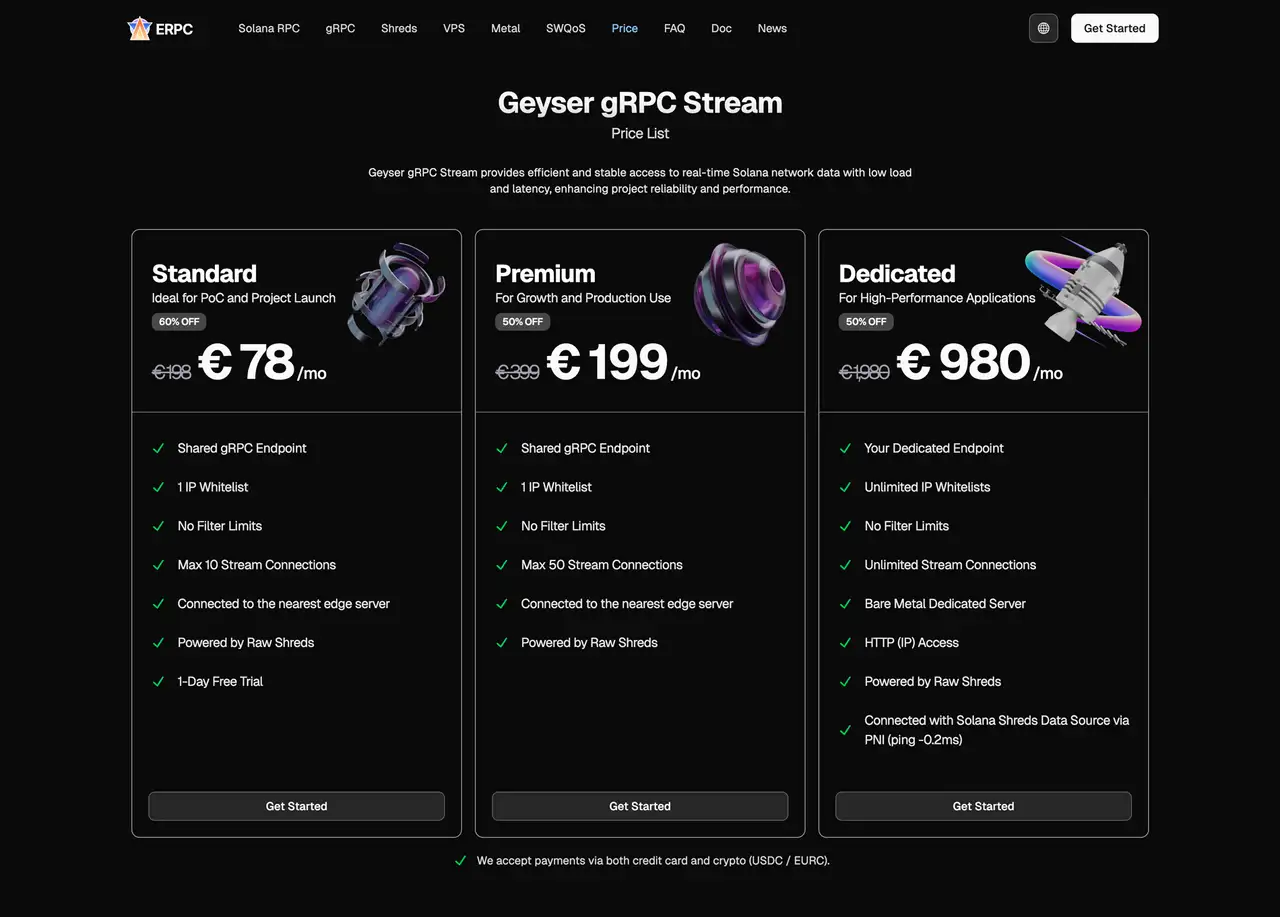
ERPC provides Geyser gRPC endpoints across multiple regions, including Frankfurt, Amsterdam, New York, Chicago, Tokyo, and Singapore. This multi-region deployment is designed to reduce regional disadvantages caused by time-of-day or network conditions.
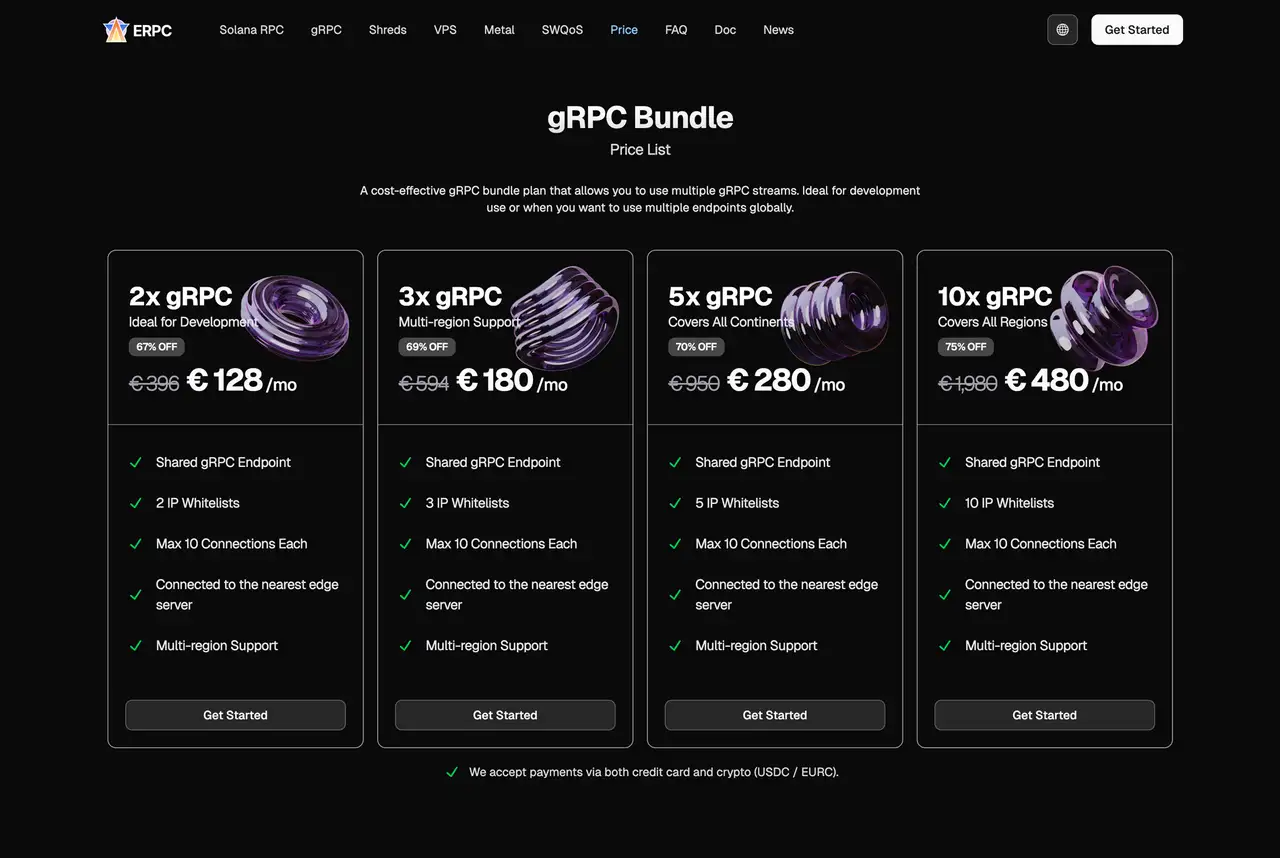
Geyser gRPC is available as both single-region plans and a gRPC Bundle plan that enables access to multiple regions under a single contract. The newly published documentation applies equally to all of these plans.
Looking Ahead
ERPC will continue to improve the performance of its streaming infrastructure, including Geyser gRPC, while also feeding operational knowledge back into documentation and code examples.
The goal is not only a fast platform, but one that can be used correctly and reliably in real-world applications.
Inquiries and Support
For consultation on region selection, plan choice, or migration from existing architectures, individual support is available via the Validators DAO official Discord.
- Validators DAO Official Discord: https://discord.gg/C7ZQSrCkYR
- ERPC Official Website: https://erpc.global/en
News