
ERPC Launches 5th Gen EPYC High-Performance Dedicated Solana RPC Nodes with Geyser gRPC Option — Maximum Performance Mode with Physical Core Concentration, SWQoS-Ready Staking Power Option Now Available
ERPC Launches 5th Gen EPYC High-Performance Dedicated Solana RPC Nodes with Geyser gRPC Option — Maximum Performance Mode with Physical Core Concentration, SWQoS-Ready Staking Power Option Now Available
ERPC, operated by ELSOUL LABO B.V. (Amsterdam) and Validators DAO, has announced a refreshed lineup of Dedicated Solana RPC Nodes featuring high-performance configurations powered by AMD EPYC 5th Gen CPUs and plans with Geyser gRPC streaming support.
Additionally, the Max configuration with physical core concentration in maximum performance mode, along with a SWQoS-ready staking power option (€100/month per 1,000 SOL), is now available. Looking ahead, ERPC will develop a SWQoS marketplace designed to create an optimal match between validators seeking to provide staking power and dedicated node holders seeking to utilize it.
What Is a Dedicated Solana RPC Node — The Fundamental Difference from Shared Nodes
The Structural Limitation of Shared Nodes
On a typical shared Solana RPC node, queries and transaction submissions from multiple users are processed on the same node. Every request follows a strict processing order, and when your request gets processed depends on the load generated by other users at that exact moment.
In other words, shared nodes have an element of "luck" structurally built in. No matter how well you optimize your application, response times fluctuate and transaction submission timing varies based on the load from other users on the same node. As long as you share RPC bandwidth with others, there is one extra layer of contention and congestion — this is the structural limitation of shared nodes.
What Dedicated Nodes Eliminate
A Dedicated Solana RPC Node is a configuration where you exclusively own the entire RPC bandwidth. Since no other users' queries or transactions are mixed in, all node resources are concentrated solely on your requests.
By structurally eliminating the processing order competition and congestion effects from other users on the same RPC node — effects that were unavoidable on shared nodes — response time variability becomes primarily dependent on the node's own processing capability and network conditions, resulting in a far more predictable configuration. The element of "luck" is removed from the RPC layer, creating an environment where you consistently receive the fastest possible response to your requests.
On Solana, transaction submission timing is the decisive factor that determines landing order. In high-frequency trading, DeFi, and real-time processing, a configuration where you never compete with other users' requests for processing order on the RPC side translates directly into competitive advantage.
New Lineup — Standard / Pro / Max
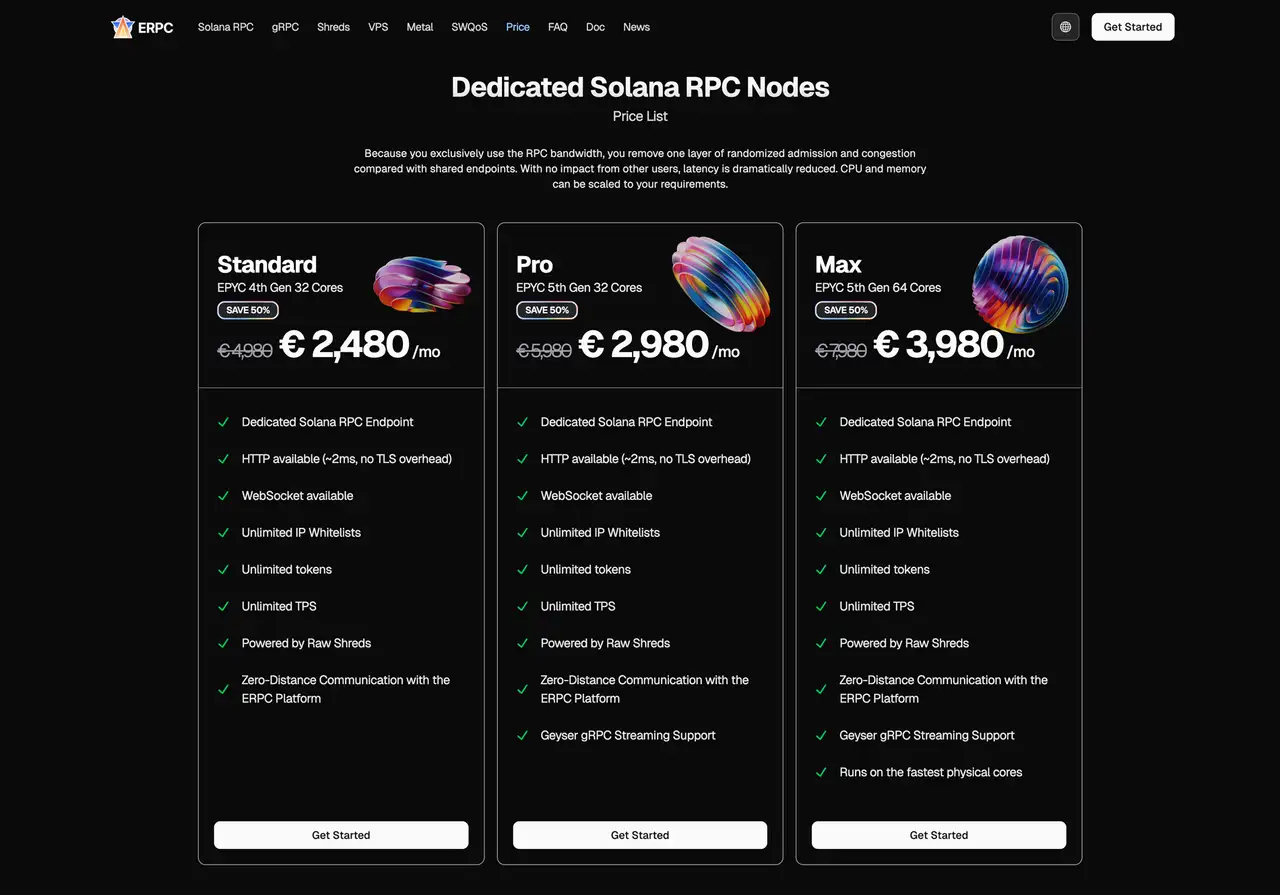
- Standard (€2,480/mo) — EPYC 4th Gen 32 Cores. Cost-effective dedicated Solana RPC configuration
- Pro (€2,980/mo) — EPYC 5th Gen 32 Cores. 5th generation processing power with Geyser gRPC streaming support
- Max (€3,980/mo) — EPYC 5th Gen 64 Cores. Overwhelming performance running on the fastest physical cores. Geyser gRPC streaming support
All plans include a Dedicated Solana RPC Endpoint, HTTP communication, WebSocket support, unlimited IP whitelists, unlimited tokens, unlimited TPS, and zero-distance communication with the ERPC platform as standard.
By employing an HTTP communication configuration that does not rely on TLS, the overhead associated with encryption processing is eliminated. Combined with VPS or bare metal servers within the ERPC platform, this enables an ultra-low-latency Solana RPC execution environment.
Pro and Max configurations include Geyser gRPC streaming support, allowing RPC method execution and real-time stream reception to be completed on a single dedicated node.
ERPC Dedicated RPC: https://erpc.global/en/rpc/
Max Configuration — Maximum Performance Mode with Physical Core Concentration
The Max configuration adopts a large-scale core layout with EPYC 5th Gen 64 cores, operating in maximum performance mode with physical core concentration.
All 64 physical cores operate in a fully optimized state: a physical core-centric configuration independent of logical threads, CPU C-state disabled, CPU governor locked to performance, kernel parameter optimization, network stack tuning, and IRQ affinity optimization — a speed-first configuration that eliminates speed-limiting factors at every layer.
For dedicated RPC nodes, abundant physical cores directly contribute not only to speed but also to stability. Processing large volumes of RPC calls, WebSocket connections, and Geyser gRPC streams simultaneously without sacrificing the latency of individual requests — the combination of speed and stability is achieved through the sheer abundance of physical core resources.
Every Day's R&D Results Are Fully Reflected
Dedicated Solana RPC Nodes are delivered with all of ERPC's R&D achievements fully applied.
Thorough elimination of power-saving and performance-throttling features, unification to HTTP communication, kernel and network stack optimization, IRQ affinity optimization — every R&D achievement accumulated through previous performance boosts is applied to dedicated nodes.
Unlike shared nodes, you enjoy these optimization benefits in their entirety without sharing them with other users. Every time ERPC's performance improves, your dedicated node's performance improves in tandem — a configuration that doesn't peak at the moment of purchase but continues to get faster as the platform evolves.
SWQoS Support — Staking Power Option
Dedicated Solana RPC Nodes come with a staking power option compatible with SWQoS (Stake-weighted Quality of Service). At €100/month per 1,000 SOL, you can assign staking power to your dedicated node and enable transaction submission through SWQoS priority lanes.
Solana's SWQoS is a mechanism where differences in access to priority bandwidth emerge based on stake size. Nodes with greater staking power can more readily secure priority lanes for transaction submission toward leader nodes. For workloads where landing order is critical, such as high-frequency trading and DeFi, this difference directly impacts landing probability and landing timing.
Future Vision — SWQoS Marketplace
ERPC will develop a SWQoS marketplace in the future.
The SWQoS marketplace is a matching platform connecting validators who want to provide staking power with dedicated node holders who want to utilize it. For validators, it expands the range of how their held stake can be leveraged, generating additional revenue. For dedicated node holders, it creates an environment where the staking power they need can be flexibly sourced.
Built on the foundation of ERPC's Solana-specialized data center (AS200261), this marketplace will create optimal matching for both validators and dedicated node holders, driving performance improvements and ecosystem growth across the entire Solana network.
Why We Build the Fastest Platform Ourselves
Trust and Brand Alone Don't Get You the Fastest
The server industry has a structural reality where the quality of resources provided varies based on the customer's level of knowledge. Data center operators have a constant incentive to conserve power and network bandwidth to improve profitability — a customer's improved performance doesn't increase the data center's revenue.
We have experienced firsthand receiving a configuration proposal that included network cards from a previous generation that did not meet the performance requirements, despite requesting the "fastest" setup. We understand from direct experience that without the customer conducting their own audits, performance bottlenecks in the infrastructure tend to go unnoticed.
The Structural Problem ERPC Solves
Traditionally, building a high-speed dedicated RPC environment on Solana required extensive and deep expertise: investigating RPC vendors' server locations, procuring bare metal servers within the same network, auditing and disabling performance-throttling settings, and tuning at every OS level.
ERPC integrates the Solana RPC platform with bare metal servers, VPS, Shreds, gRPC, and Unlimited Endpoints that users deploy — all within a single platform. Simply by deploying within the platform, you get the fastest communication conditions, pre-optimized configurations, and Solana-specific tuning from the start.
You can have the fastest environment without deep knowledge of data centers — this is ERPC's design philosophy and the reason we continue to build our own platform.
5 Consecutive Years of WBSO Approval — R&D Results Directly Reflected in Performance
ELSOUL LABO has received consecutive WBSO approvals from the Dutch government's R&D support program since 2022, marking five straight years. The company continues research on ultra-low-latency Solana RPC infrastructure and automation of validator placement and operational orchestration, with results directly reflected in platform performance improvements.
This dedicated RPC node lineup refresh is another embodiment of the knowledge accumulated through these R&D efforts in production. R&D results are cumulative, and the angle of improvement grows steeper over time.
The Next-Generation Option — AS200261 Solana-Specialized Data Center
ELSOUL LABO has been assigned its own ASN (AS200261) by RIPE NCC and is advancing the launch of a top-tier Solana-specialized data center. Designed to surpass existing premium data centers as the highest-quality infrastructure available, it is scheduled to become available from the end of this month through next month.
The hardware configuration is unified around the latest generation AMD EPYC 5th Gen, AMD Threadripper PRO 5th Gen (9975WX, etc.), and NVMe 5th Gen, combined with optimal network path engineering through the company's own ASN. This achieves what was previously considered a trade-off: both top performance and an optimal ASN concentration score.
ELSOUL LABO's Solana-specialized data center delivers both maximum performance and maximum incentives to validators and Solana developers and projects that rely on RPC. Positioned as a force that elevates the performance of the entire Solana network, it aims to serve as a growth foundation for the ecosystem in coordination with the SWQoS marketplace.
The initial lot is fully reserved, with subsequent inventory available through the waitlist in order.
Contact
For inquiries about Dedicated Solana RPC Nodes, please create a support ticket on the official Validators DAO Discord.
Validators DAO Official Discord: https://discord.gg/C7ZQSrCkYR
Official information and plans for ERPC are available at:
ERPC Official Website: https://erpc.global/en
Thank you for your continued support of ERPC.
News